
FPV Drone Frequencies: How to Choose and Use Them
Even the most expensive drone cannot reach its full potential without a stable radio link. That is why FPV drone frequencies play a crucial role in flight range, video signal quality, and control reliability.
Many beginners mistakenly believe that an FPV system operates on a single frequency. In reality, a modern drone uses multiple radio channels simultaneously, each serving a different purpose. Let's take a closer look at the different FPV drone frequencies and how to choose the optimal configuration.
How FPV Drone Frequencies Work
A typical FPV setup consists of two independent communication systems operating simultaneously:
Drone control system
Video transmission system
The control channel sends commands from the transmitter to the flight controller. Through this link, the pilot controls the drone’s direction, speed, altitude, and maneuvers.
The video channel works in the opposite direction—from the drone’s camera to the pilot’s goggles or monitor. It provides the immersive first-person view that makes FPV flying possible.
To prevent interference, these systems operate on different frequencies. If the signals overlap, packet loss, latency issues, or even complete signal loss can occur.
In addition, many modern systems use telemetry, which transmits data such as battery voltage, GPS coordinates, flight speed, and other important parameters.
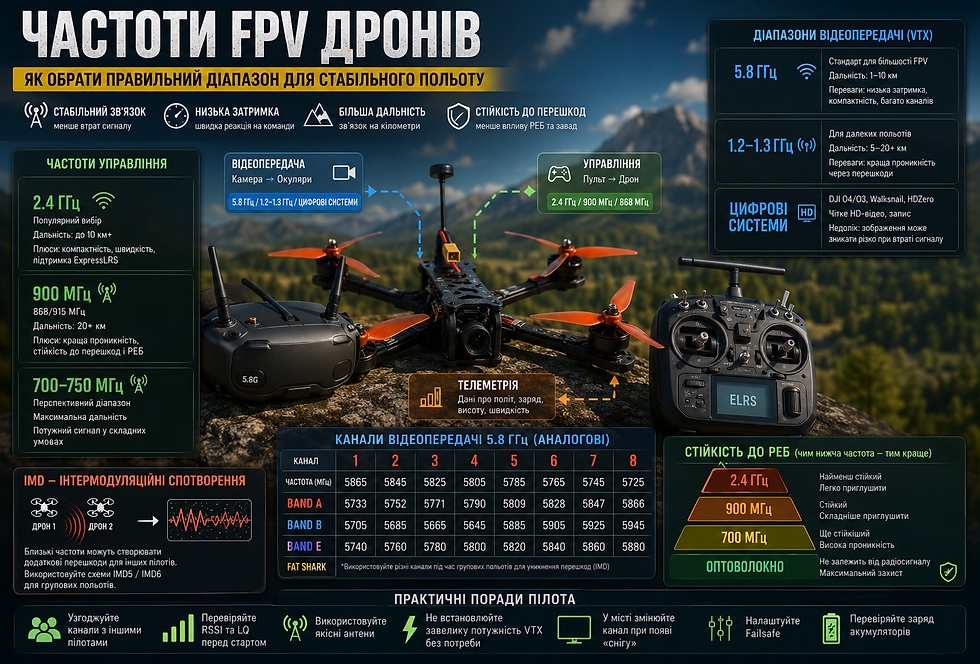
Main Video Transmission Frequencies
5.8 GHz — The Industry Standard
The most widely used frequency band for FPV video today is 5.8 GHz.
Its popularity is driven by several advantages:
Compact antennas
Low signal latency
Wide availability of equipment
Support for both analog and digital systems
Under favorable conditions, flight range can vary from 1 to 10 km depending on transmitter power, antenna type, and terrain.
The main drawback is sensitivity to physical obstacles. Buildings, trees, and uneven terrain can significantly weaken the signal.
1.2–1.3 GHz for Long-Range Flights
For extended-range operations, many pilots use the 1.2–1.3 GHz band.
Its key benefits include:
Better obstacle penetration
More stable connections over long distances
Reduced impact from urban environments
This is why it remains popular among Long Range FPV enthusiasts.
However, the required antennas are larger and heavier, making them less suitable for compact drones.
Digital FPV Systems
In recent years, digital video transmission technologies have advanced rapidly, including:
DJI O4 Air Unit
DJI O3 Air Unit
Walksnail Avatar HD
HDZero
Most of these systems also operate around 5.8 GHz but use digital signal transmission.
Advantages of digital FPV include:
High-resolution video
Crystal-clear image quality
Improved detail
HD recording capabilities without a separate action camera
The downside is that digital systems often follow an "all-or-nothing" principle. When signal quality drops below a critical threshold, the image may disappear almost instantly.
FPV Drone Control Frequencies
2.4 GHz — The Universal Choice
Today, most pilots use 2.4 GHz for control.
Reasons for its popularity include:
Compact antennas
Affordable equipment
Fast command transmission
Full support for the ExpressLRS protocol
With the introduction of ELRS, the effective range of 2.4 GHz systems has increased dramatically. With proper tuning and quality antennas, reliable control can be maintained over tens of kilometers.
868 MHz and 915 MHz
Lower frequencies provide better signal penetration and greater resistance to interference.
Different regions typically use:
868 MHz (Europe)
915 MHz (United States and other regions)
Systems operating in these bands include:
ExpressLRS 900 MHz
TBS Crossfire
Various long-range radio systems
Their main advantage is maintaining a stable connection even in difficult terrain or densely built-up areas.
ExpressLRS — The New FPV Standard
While the market was once dominated by FrSky, FlySky, and Crossfire, more and more pilots are now switching to ExpressLRS.
ELRS uses open-source software and advanced data transmission algorithms.
Its key advantages include:
Ultra-low latency
Exceptional range
Fast packet rates
Frequency Hopping support
Regular firmware updates
Frequency Hopping continuously changes operating channels, helping maintain reliable communication even in environments with significant radio interference.
For this reason, ELRS is widely considered the most promising radio control solution for modern FPV drones.
How Frequency Affects Flight Range
There is a fundamental rule in radio communications:
The lower the frequency, the better the signal penetrates obstacles and maintains range.
Approximate comparison:
Frequency | Penetration | Range |
5.8 GHz | Low | Medium |
2.4 GHz | Medium | High |
900 MHz | High | Very High |
700 MHz | Maximum | Maximum |
However, lower frequencies require larger antennas, which may be impractical for lightweight FPV drones.
What Is IMD and Why Does It Matter?
When multiple FPV pilots fly together, several video transmitters operate simultaneously. If channels are too close to each other, intermodulation distortion (IMD) can occur.
This can result in:
Increased noise
Reduced video quality
Temporary video dropouts
To avoid these issues during races and large events, pilots use dedicated channel plans such as:
IMD5
IMD6
MultiGP Race Channels
These frequency layouts allow multiple drones to fly simultaneously with minimal interference.
FPV Drone Frequencies and Resistance to Electronic Warfare
Modern electronic warfare (EW) systems operate by generating powerful radio-frequency noise on specific bands.
In general, resistance to jamming can be ranked as follows:
2.4 GHz — most vulnerable
900 MHz — better resistance
700–800 MHz — even harder to jam
Fiber-optic systems — completely independent of radio signals
However, it is important to understand that no radio system is completely immune to modern electronic warfare. Even advanced systems can experience signal loss under challenging conditions.
Which FPV Drone Frequencies Should You Choose?
For Beginners
Recommended setup:
Control: ELRS 2.4 GHz
Video: 5.8 GHz
This configuration is easy to set up and offers a wide selection of compatible hardware.
For Freestyle Flying
Most freestyle pilots use:
ELRS 2.4 GHz
Analog or digital 5.8 GHz video
This combination provides minimal latency and maximum responsiveness.
For Long Range
Recommended configuration:
ELRS 868/915 MHz
1.3 GHz video or a high-power 5.8 GHz digital system
This setup offers maximum range and connection reliability.
Practical Pre-Flight Checklist
Before every FPV flight, verify the following:
Correct video channel selection
Antenna condition and installation
Video transmitter power level
RSSI and LQ values
FailSafe configuration
Battery charge level
No frequency conflicts with nearby pilots
Spending just a few minutes on these checks can prevent drone loss and ensure a successful flight.
FPV drone frequencies directly affect control quality, flight range, and video signal stability. For most pilots, the optimal combination remains ELRS 2.4 GHz for control and 5.8 GHz for video transmission. However, for long-range missions and operations in demanding environments, 868/915 MHz control systems and alternative video frequencies are worth considering.
Choosing the right frequency setup allows you to maximize your drone’s performance, improve flight safety, and maintain reliable communication even under challenging operating conditions.


