
FPV Drone Radio Communication: How Antennas, Polarization, and Signal Loss Work
Unmanned technologies play one of the key roles on today's battlefield. The quality of radio communication directly affects mission success and the survivability of the aircraft itself. That is why understanding the fundamentals of antennas, frequencies, and radio wave propagation is no longer a matter reserved exclusively for engineers.
At the same time, it is important to recognize that radio communication is a complex discipline that cannot be fully explained in a single article. The goal of this guide is to provide a solid foundation and help readers understand the basic principles behind modern FPV communication systems.
Two Primary Communication Channels that matter for FPV Drone Radio Communication
Every FPV drone relies on two independent radio links:
The control link, used to transmit commands from the pilot to the drone.
The video link, used to transmit camera footage from the drone to the operator.
Each channel operates on its own frequency range and uses dedicated antennas. This is why the term “drone antenna” is somewhat misleading—different systems have different requirements and purposes.
Key Antenna Characteristics
Operating frequency
Polarization
Gain
Radiation pattern
Polarization: Why Identical Antennas May Not Work Together
Polarization describes the direction in which an electromagnetic wave oscillates as it propagates through space.
There are two primary types of polarization:
Linear polarization
Circular polarization
Linear Polarization
Linear polarization can be:
Vertical
Horizontal
Circular Polarization
Circular polarization is divided into:
Right-Hand Circular Polarization (RHCP)
Left-Hand Circular Polarization (LHCP)
For reliable communication, both the transmitting and receiving antennas must use the same type of polarization. Failure to do so can result in severe signal losses, making communication extremely difficult or even impossible.

How FPV Drone Control Systems Work
The most common frequencies used for transmitting control commands are:
868 MHz
915 MHz
2.4 GHz
In most cases, these systems use linear polarization.
In theory, operators can orient their antennas either vertically or horizontally. In practice, however, most FPV drones have fixed receiver antenna positions, making horizontal polarization the more common choice.
If two antennas are positioned perpendicular to each other, signal losses can reach approximately 20 dB—effectively resulting in a near-total loss of communication.
Fortunately, drones constantly change orientation during flight, making a perfectly perpendicular alignment relatively rare and allowing the system to remain functional in most situations.
Video Transmission: Why FPV Systems Use Circular Polarization
Video transmission systems typically operate on:
1.2 GHz
5.8 GHz
Most FPV systems use Right-Hand Circularly Polarized (RHCP) antennas.
Historically, RHCP became the dominant standard within the FPV community. The common belief that right-hand polarization is intended for analog video while left-hand polarization is intended for digital systems has no technical basis.
The rule is simple: both ends of the communication link must use the same polarization.
If one antenna is RHCP and the other is LHCP, signal losses can again reach approximately 20 dB.
Interestingly, a circularly polarized signal can be received by a linearly polarized antenna, although this typically results in a loss of about 3 dB.
Radio Horizon: The Invisible Limitation
One of the biggest enemies of radio communication is the geometry of our planet.
Radio waves primarily propagate within line-of-sight conditions. When a drone moves beyond the radio horizon, signal quality deteriorates rapidly and may disappear entirely.
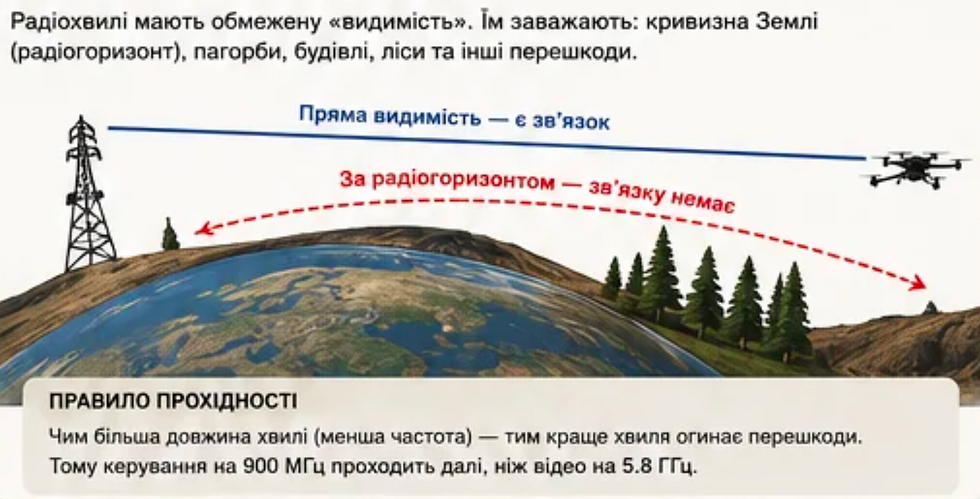
In addition to Earth's curvature, communication can be affected by:
Hills and terrain features
Tree lines and forests
Concrete structures
Metal constructions
Dense urban development
Different frequencies interact with obstacles differently. The general rule is simple:
The lower the frequency, the better it can diffract around obstacles
This is why a control link operating around 900 MHz often maintains stable communication over longer distances than a 5.8 GHz video link.
Omnidirectional and Directional Antennas
Most antennas mounted on drones are omnidirectional.
Their primary advantage is obvious: they provide communication regardless of the drone's orientation.
However, when greater range is required, directional antennas are commonly used.
Among the most popular types are:
Patch antennas
Yagi antennas
Helix antennas
Their operating principle is based on concentrating radio energy into a specific sector of space.
As a result:
Communication range increases
Reception quality improves
Coverage area becomes narrower
Gain and Radiation Pattern
Every directional antenna has two key characteristics:
Antenna Gain
Measured in dBi, gain indicates how effectively an antenna concentrates radio energy.
Radiation Pattern
The radiation pattern describes the area in which the signal remains strong enough for reliable operation.
A critical trade-off exists:
Higher gain = greater range
Higher gain = narrower coverage
For example, a 6 dBi antenna may provide a relatively wide coverage sector, while a 20 dBi antenna creates a very narrow radio corridor.
A drone leaving this corridor is often the reason for signal loss, even when no technical malfunction is present.
Electronic Warfare (EW): A Factor That Cannot Be Ignored
Modern battlefields are heavily saturated with electronic warfare systems.
However, it is important to remember that no EW system is universally effective.
Its performance depends on several factors:
Transmitter power
Operating frequencies
Terrain conditions
Available power sources
Deployment tactics
Practical experience shows that operators often improve system survivability by:
Using less common frequency bands
Modifying antenna configurations
Reducing video transmitter power to lower detectability
Carefully planning flight routes
The competition between electronic warfare systems and unmanned platforms resembles an ongoing technological race, where every new solution eventually leads to a new countermeasure.
Conclusion
Successful FPV drone operations depend not only on aircraft quality and pilot skill. A deep understanding of radio waves, proper antenna selection, awareness of terrain effects, and effective equipment configuration all play crucial roles in FPV Drone Radio Communication.
Understanding polarization, frequencies, the radio horizon, and antenna directivity can significantly improve the effectiveness of unmanned systems while helping operators avoid many common mistakes.
The better an operator understands the physics of radio communication, the greater the chances that their drone will successfully return after completing its mission.


